It's too topical for this blog, but I have a nice piece on corporate greed at my blog:
Hari's Place: Genentech = Greedintech?
Saturday, June 17, 2006


Thursday, June 15, 2006
Black Elk Speaks
"Peace.....comes within the souls of men when they realize their relationship, their oneness with the universe and all its powers, and when they realize that at the center of the universe dwells Wankan tanka, and that this center is really everywhere. It is within each of us."
Black Elk, Oglala Elder
Black Elk, Oglala Elder
Friday, June 09, 2006
What do you know about death?
Global road safety factfile
* Worldwide, the number of people killed in road traffic crashes each year is estimated to be almost 1.2 million. That’s 3000 people killed on the world’s roads every day
* The number injured in road traffic accidents is estimated to be as high as 50 million – the combined population of five of the world’s large cities
* According to World Health Organisation data, deaths from road traffic injuries account for around 25% of all deaths from injury
* It is expected that, without efforts and new initiatives to tackle the causes of road traffic injuries and deaths, they will rise by some 65% between 2000 and 2020
* Over 50% of deaths are among young adults in the age range of 15-44 years. For men aged 15-44 road traffic injuries rank second (behind HIV/AIDS) as the leading cause of premature death and ill health worldwide
* Among both children aged 5-14 years and young people aged 15-29 years, road traffic injuries are the second-leading cause of death worldwide
* More than 80% of those killed in road traffic crashes live in middle and low income countries
* Road traffic deaths are predicted to rise on average by more than 80% in low and middle income countries by 2020
* According to World Bank forecasts, South East Asia will see a 144% increase in road deaths by 2020, from a base date of 2000. If no significant remedial action is taken, India’s death rate is not expected to begin to decline until 2042. Sub Saharan Africa is forecast to experience at least 80% more road deaths in 2020 than in 2000. The Middle East and North Africa are forecast to see a 68% increase in road deaths over the same period 2000-2020
* Overall, road deaths are predicated to rise above 2 million a year by 2020, and to move from the 10th to 3rd cause of premature death and disability
* The World Bank recently estimated that developing countries lose approximately US$100 billion every year due to road crashes. This figure is twice the amount of all development aid provided by donors to developing countries
* Africa bears a huge economic burden from road traffic crashes. Despite having very low levels of motorisation, 10% of global road fatalities occur in Africa and are conservatively estimated to cost the continent approximately US$3.7 billion a year
* Road crashes are estimated to cost most African countries between 0.8 and 5% of their GNP. Furthermore, according to projections by the WHO the economic cost of road crashes in Africa is expected to increase by 80% over the next seven years
Source: Commission for Global Road Safety
- Satyagraha!
* Worldwide, the number of people killed in road traffic crashes each year is estimated to be almost 1.2 million. That’s 3000 people killed on the world’s roads every day
* The number injured in road traffic accidents is estimated to be as high as 50 million – the combined population of five of the world’s large cities
* According to World Health Organisation data, deaths from road traffic injuries account for around 25% of all deaths from injury
* It is expected that, without efforts and new initiatives to tackle the causes of road traffic injuries and deaths, they will rise by some 65% between 2000 and 2020
* Over 50% of deaths are among young adults in the age range of 15-44 years. For men aged 15-44 road traffic injuries rank second (behind HIV/AIDS) as the leading cause of premature death and ill health worldwide
* Among both children aged 5-14 years and young people aged 15-29 years, road traffic injuries are the second-leading cause of death worldwide
* More than 80% of those killed in road traffic crashes live in middle and low income countries
* Road traffic deaths are predicted to rise on average by more than 80% in low and middle income countries by 2020
* According to World Bank forecasts, South East Asia will see a 144% increase in road deaths by 2020, from a base date of 2000. If no significant remedial action is taken, India’s death rate is not expected to begin to decline until 2042. Sub Saharan Africa is forecast to experience at least 80% more road deaths in 2020 than in 2000. The Middle East and North Africa are forecast to see a 68% increase in road deaths over the same period 2000-2020
* Overall, road deaths are predicated to rise above 2 million a year by 2020, and to move from the 10th to 3rd cause of premature death and disability
* The World Bank recently estimated that developing countries lose approximately US$100 billion every year due to road crashes. This figure is twice the amount of all development aid provided by donors to developing countries
* Africa bears a huge economic burden from road traffic crashes. Despite having very low levels of motorisation, 10% of global road fatalities occur in Africa and are conservatively estimated to cost the continent approximately US$3.7 billion a year
* Road crashes are estimated to cost most African countries between 0.8 and 5% of their GNP. Furthermore, according to projections by the WHO the economic cost of road crashes in Africa is expected to increase by 80% over the next seven years
Source: Commission for Global Road Safety
- Satyagraha!
Wednesday, May 31, 2006
Monday, May 15, 2006
I'm So Bored With The U S A
Yankee soldier
He wanna shoot some skag
He met it in Cambodia
But now he can't afford a bag
Yankee dollar talk
To the dictators of the world
In fact it's giving orders
An' they can't afford to miss a word
I'm so bored with the U...S...A...
But what can I do?
Yankee detectives
Are always on the TV
'Cos killers in America
Work seven days a week
Never mind the stars and stripes
Let's print the Watergate Tapes
I'll salute the New Wave
And I hope nobody escapes
I'm so bored with the U...S...A...
But what can I do?
Move up Starsky
For the C.I.A.
Suck on Kojak
For the USA
- Joe Strummer (born John Graham Mellor) and Michael Geoffrey ("Mick") Jones
Satyagraha!
He wanna shoot some skag
He met it in Cambodia
But now he can't afford a bag
Yankee dollar talk
To the dictators of the world
In fact it's giving orders
An' they can't afford to miss a word
I'm so bored with the U...S...A...
But what can I do?
Yankee detectives
Are always on the TV
'Cos killers in America
Work seven days a week
Never mind the stars and stripes
Let's print the Watergate Tapes
I'll salute the New Wave
And I hope nobody escapes
I'm so bored with the U...S...A...
But what can I do?
Move up Starsky
For the C.I.A.
Suck on Kojak
For the USA
- Joe Strummer (born John Graham Mellor) and Michael Geoffrey ("Mick") Jones
Satyagraha!
War
"It makes no difference what men think of war, said the judge. War endures. As well ask men what they think of stone. War was always here. Before man was, war waited for him. The ultimate trade awaiting its ultimate practitioner. That is the way it was and will be. That way and not some other way."
- Cormac McCarthy, Blood Meridian
Snotyergrandma!
- Cormac McCarthy, Blood Meridian
Snotyergrandma!
Friday, May 12, 2006
Why "Satanic"?
If you get down and you quarrel everyday,
You're saying prayers to the devils, I say.
Why not help one another on the way?
Make it much easier. Just a little bit easier.
- Bob Marley, Positive Vibration
Satyagraha!
You're saying prayers to the devils, I say.
Why not help one another on the way?
Make it much easier. Just a little bit easier.
- Bob Marley, Positive Vibration
Satyagraha!
Thursday, May 11, 2006
Buddhism's Satanic Verses
Upaka, a man belonging to the Ajivika sect of naked ascetics met the Blessed One travelling on the road between Gaya and the Bodhi tree. When he saw him, he said to the Blessed One: "Friend, your countenance is serene and your complexion is pure and bright. In whose name have you retired from the world? Who is your teacher? Whose doctrine do you profess?"
The Blessed One replied: "I have overcome all foes. I am all-wise. I am free from all stain. I have abandoned everything and obtained emancipation by the destruction of desire. Having gained this knowledge myself, who should I call my master? I have no teacher. No one is equal to me. In the world of men and of gods no being is like me. I am the holy One in this world. I am the highest teacher, I alone am the Absolute Sambuddha; I have gained calm by the extinction of all passion and I have obtained Nirvana. To found the Kingdom of Truth I go to the city of Kashi (Benares), where I will beat the drum of the Immortal in the darkness of this world.'"
Upaka the Ajivika then asked: "You profess then, friend, to be the holy, absolute Jina?"
Buddha replied: "All Jinas have like me reached extinction of the Asavas. I have overcome all states of sinfulness and therefore, Upaka, I am the Jina.'
Upaka the Ajivika replied: "It may be so, friend, it may be so." as he shook his head and went his way on another road.
- Mahavagga (Khandaka) I, 7-9 of the Vinaya Pitaka of the Pali Canon
Definitions:
Jina = "the victorious One", commonly attributed to both the historical Buddha and Mahavira, the ultimate Jaina thirtankara.
Asava = sensuality, individuality, delusion and ignorance.
Ajivika = an ascetic tradition reputedly founded by Gosala Maskariputra (a.k.a. Ekadanda - he who carries a single staff) just before the time of the historical Buddha. Gosala rejected prevailing beliefs based upon the role of devotion (e.g. Brahminism), individual effort (e.g. yoga) or spiritual heroes (e.g. Jainism, Buddhism) in facilitating the release of the incorruptible, immortal aspect of living beings from attachment to the material universe (e.g. karma). Gosala taught that this detachment happened of its own accord under the influence of blind, impersonal destiny (niyati). Other ajivika teachers proposed that what appear to us to be attachments and developments are merely illusions of our limited human conceptions of time and space: each atom is the universe, each moment is eternity. Needless to say, the Ajivikas were attacked by followers of all other traditions who clung to heroes and divine intercessors in the search for a way around the blind blundering of destiny.
Grahasatya, Ekadanda!
The Blessed One replied: "I have overcome all foes. I am all-wise. I am free from all stain. I have abandoned everything and obtained emancipation by the destruction of desire. Having gained this knowledge myself, who should I call my master? I have no teacher. No one is equal to me. In the world of men and of gods no being is like me. I am the holy One in this world. I am the highest teacher, I alone am the Absolute Sambuddha; I have gained calm by the extinction of all passion and I have obtained Nirvana. To found the Kingdom of Truth I go to the city of Kashi (Benares), where I will beat the drum of the Immortal in the darkness of this world.'"
Upaka the Ajivika then asked: "You profess then, friend, to be the holy, absolute Jina?"
Buddha replied: "All Jinas have like me reached extinction of the Asavas. I have overcome all states of sinfulness and therefore, Upaka, I am the Jina.'
Upaka the Ajivika replied: "It may be so, friend, it may be so." as he shook his head and went his way on another road.
- Mahavagga (Khandaka) I, 7-9 of the Vinaya Pitaka of the Pali Canon
Definitions:
Jina = "the victorious One", commonly attributed to both the historical Buddha and Mahavira, the ultimate Jaina thirtankara.
Asava = sensuality, individuality, delusion and ignorance.
Ajivika = an ascetic tradition reputedly founded by Gosala Maskariputra (a.k.a. Ekadanda - he who carries a single staff) just before the time of the historical Buddha. Gosala rejected prevailing beliefs based upon the role of devotion (e.g. Brahminism), individual effort (e.g. yoga) or spiritual heroes (e.g. Jainism, Buddhism) in facilitating the release of the incorruptible, immortal aspect of living beings from attachment to the material universe (e.g. karma). Gosala taught that this detachment happened of its own accord under the influence of blind, impersonal destiny (niyati). Other ajivika teachers proposed that what appear to us to be attachments and developments are merely illusions of our limited human conceptions of time and space: each atom is the universe, each moment is eternity. Needless to say, the Ajivikas were attacked by followers of all other traditions who clung to heroes and divine intercessors in the search for a way around the blind blundering of destiny.
Grahasatya, Ekadanda!
Wednesday, May 10, 2006
To the Bazaar Today
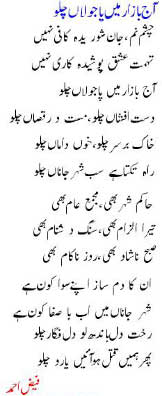
Chashm-e Nam, Jan-e Shoreeda kafi nahin
Thumat-e Ishq poshida kafi nahin,
Aaj bazaar mein pabajolan chalo
Dast afshan chalo, Mast o Raqsaan chalo
Khaq bar sar chalo, khon bad-aman chalo
Rah takta ha sab Shahr-e Janaan chalo
Hakim-e Shaher bhi, Mujmaa-e Aam bhi,
Teer-i Ilzam bhi, Sang-e Dushnam bhi,
Subh nashaad bhi, Roz-i nakam bhi
Un ka dam saz apnay siva kon hai
Shehr-e Janaan mein ab ba-Sufa kon hai,
Dast-Katil kay shaiyan raha kon hai
Rakht-i dil bandh lo, dil fogaro chalo
Phir hamien Katl ho aiyn, Yaro Chalo
- Faiz Ahmed Faiz, 1959 (written in the Lahore Jail)
A dampened eye, a wasted life: nothing,
Accusations of a hidden love: nothing,
To the bazaar today in chains let us go.
Palms waving let us go; wildly dancing let us go,
Dusty haired let us go; blood spattered let us go,
As the City of Lovers watches, down the road let us go.
The princes of the keep and the common crowding folk,
The shafts of accusation and the hurled stones of rebuke,
The gloom of a dire morning and the failing of a dismal day,
Who among them is alive, but us?
Who among them is innocent, but us?
Who will honour the bloody blade, but us?
Ye brokenhearted make ready, let us go,
Yet again to death, dear friends let us go.
Satyagraha!
Monday, May 08, 2006
Islam's Satanic Verses
Rushdie had it wrong - here's the real problem:
"4.150": Surely those who disbelieve in Allah and His apostles and (those who) desire to make a distinction between Allah and His apostles and say: We believe in some and disbelieve in others, and desire to take a course between (this and) that.
"4.151": These it is that are truly unbelievers, and We have prepared for the unbelievers a disgraceful chastisement.
"4.152": And those who believe in Allah and His apostles and do not make a distinction between any of them -- Allah will grant them their rewards; and Allah is Forgiving, Merciful.
"4.153": The followers of the Book ask you to bring down to them a book from heaven; so indeed they demanded of Musa a greater thing than that, for they said: Show us Allah manifestly; so the lightning overtook them on account of their injustice. Then they took the calf (for a god), after clear signs had come to them, but We pardoned this; and We gave to Musa clear authority.
"4.154": And We lifted the mountain (Sainai) over them at (the taking of the covenant) and We said to them: Enter the door making obeisance; and We said to them: Do not exceed the limits of the Sabbath, and We made with them a firm covenant.
"4.155": Therefore, for their breaking their covenant and their disbelief in the communications of Allah and their killing the prophets wrongfully and their saying: Our hearts are covered; nay! Allah set a seal upon them owing to their unbelief, so they shall not believe except a few.
"4.156": And for their unbelief and for their having uttered against Marium a grievous calumny.
"4.157": And their saying: Surely we have killed the Messiah, Isa son of Marium, the apostle of Allah; and they did not kill him nor did they crucify him, but it appeared to them so (like Isa) and most surely those who differ therein are only in a doubt about it; they have no knowledge respecting it, but only follow a conjecture, and they killed him not for sure.
"4.158": Nay! Allah took him up to Himself; and Allah is Mighty, Wise.
"4.159": And there is not one of the followers of the Book but most certainly believes in this before his death, and on the day of resurrection he (Isa) shall be a witness against them.
"4.160": Wherefore for the iniquity of those who are Jews did We disallow to them the good things which had been made lawful for them and for their hindering many (people) from Allah's way.
"4.161": And their taking usury though indeed they were forbidden it and their devouring the property of people falsely, and We have prepared for the unbelievers from among them a painful chastisement.
"4.162": But the firm in knowledge among them and the believers believe in what has been revealed to. you and what was revealed before you, and those who keep up prayers and those who give the poor-rate and the believers in Allah and the last day, these it is whom We will give a mighty reward.
"4.163": Surely We have revealed to you as We revealed to Nuh, and the prophets after him, and We revealed to Ibrahim and Ismail and Ishaq and Yaqoub and the tribes, and Isa and Ayub and Yunus and Haroun and Sulaiman and We gave to Dawood
"4.164": And (We sent) apostles We have mentioned to you before and apostles we have not mentioned to you; and to Musa, Allah addressed His Word, speaking (to him):
"4.165": (We sent) apostles as the givers of good news and as warners, so that people should not have a plea against Allah after the (coming of) apostles; and Allah is Mighty, Wise.
"4.166": But Allah bears witness by what He has revealed to you that He has revealed it with His knowledge, and the angels bear witness (also); and Allah is sufficient as a witness.
"4.167": Surely (as for) those who disbelieve and hinder (men) from Allah's way, they indeed have strayed off into a remote
"4.168": Surely (as for) those who disbelieve and act unjustly Allah will not forgive them nor guide them to a path
"4.169": Except the path of hell, to abide in it for ever, and this is easy to Allah.
"4.170": O people! surely the Apostle has come to you with the truth from your Lord, therefore believe, (it shall be) good for you and If you disbelieve, then surely whatever is in the heavens and the earth is Allah's; and Allah is Knowing, Wise.
"4.171": O followers of the Book! do not exceed the limits in your religion, and do not speak (lies) against Allah, but (speak) the truth; the Messiah, Isa son of Marium is only an apostle of Allah and His Word which He communicated to Marium and a spirit from Him; believe therefore in Allah and His apostles, and say not, Three. Desist, it is better for you; Allah is only one God; far be It from His glory that He should have a son, whatever is in the heavens and whatever is in the earth is His, and Allah is sufficient for a Protector.
Greetings from dar-al-Harb!
"4.150": Surely those who disbelieve in Allah and His apostles and (those who) desire to make a distinction between Allah and His apostles and say: We believe in some and disbelieve in others, and desire to take a course between (this and) that.
"4.151": These it is that are truly unbelievers, and We have prepared for the unbelievers a disgraceful chastisement.
"4.152": And those who believe in Allah and His apostles and do not make a distinction between any of them -- Allah will grant them their rewards; and Allah is Forgiving, Merciful.
"4.153": The followers of the Book ask you to bring down to them a book from heaven; so indeed they demanded of Musa a greater thing than that, for they said: Show us Allah manifestly; so the lightning overtook them on account of their injustice. Then they took the calf (for a god), after clear signs had come to them, but We pardoned this; and We gave to Musa clear authority.
"4.154": And We lifted the mountain (Sainai) over them at (the taking of the covenant) and We said to them: Enter the door making obeisance; and We said to them: Do not exceed the limits of the Sabbath, and We made with them a firm covenant.
"4.155": Therefore, for their breaking their covenant and their disbelief in the communications of Allah and their killing the prophets wrongfully and their saying: Our hearts are covered; nay! Allah set a seal upon them owing to their unbelief, so they shall not believe except a few.
"4.156": And for their unbelief and for their having uttered against Marium a grievous calumny.
"4.157": And their saying: Surely we have killed the Messiah, Isa son of Marium, the apostle of Allah; and they did not kill him nor did they crucify him, but it appeared to them so (like Isa) and most surely those who differ therein are only in a doubt about it; they have no knowledge respecting it, but only follow a conjecture, and they killed him not for sure.
"4.158": Nay! Allah took him up to Himself; and Allah is Mighty, Wise.
"4.159": And there is not one of the followers of the Book but most certainly believes in this before his death, and on the day of resurrection he (Isa) shall be a witness against them.
"4.160": Wherefore for the iniquity of those who are Jews did We disallow to them the good things which had been made lawful for them and for their hindering many (people) from Allah's way.
"4.161": And their taking usury though indeed they were forbidden it and their devouring the property of people falsely, and We have prepared for the unbelievers from among them a painful chastisement.
"4.162": But the firm in knowledge among them and the believers believe in what has been revealed to. you and what was revealed before you, and those who keep up prayers and those who give the poor-rate and the believers in Allah and the last day, these it is whom We will give a mighty reward.
"4.163": Surely We have revealed to you as We revealed to Nuh, and the prophets after him, and We revealed to Ibrahim and Ismail and Ishaq and Yaqoub and the tribes, and Isa and Ayub and Yunus and Haroun and Sulaiman and We gave to Dawood
"4.164": And (We sent) apostles We have mentioned to you before and apostles we have not mentioned to you; and to Musa, Allah addressed His Word, speaking (to him):
"4.165": (We sent) apostles as the givers of good news and as warners, so that people should not have a plea against Allah after the (coming of) apostles; and Allah is Mighty, Wise.
"4.166": But Allah bears witness by what He has revealed to you that He has revealed it with His knowledge, and the angels bear witness (also); and Allah is sufficient as a witness.
"4.167": Surely (as for) those who disbelieve and hinder (men) from Allah's way, they indeed have strayed off into a remote
"4.168": Surely (as for) those who disbelieve and act unjustly Allah will not forgive them nor guide them to a path
"4.169": Except the path of hell, to abide in it for ever, and this is easy to Allah.
"4.170": O people! surely the Apostle has come to you with the truth from your Lord, therefore believe, (it shall be) good for you and If you disbelieve, then surely whatever is in the heavens and the earth is Allah's; and Allah is Knowing, Wise.
"4.171": O followers of the Book! do not exceed the limits in your religion, and do not speak (lies) against Allah, but (speak) the truth; the Messiah, Isa son of Marium is only an apostle of Allah and His Word which He communicated to Marium and a spirit from Him; believe therefore in Allah and His apostles, and say not, Three. Desist, it is better for you; Allah is only one God; far be It from His glory that He should have a son, whatever is in the heavens and whatever is in the earth is His, and Allah is sufficient for a Protector.
Greetings from dar-al-Harb!
A Zen Take on Christianity
God against man.
Man against God.
Man against nature.
Nature against man.
Nature against God.
God against nature.
Very funny religion!
- Daisetz Teitaro Suzuki
Satyagraha!
Man against God.
Man against nature.
Nature against man.
Nature against God.
God against nature.
Very funny religion!
- Daisetz Teitaro Suzuki
Satyagraha!
Saturday, May 06, 2006
Water No Get Enemy
To ba fe lo weh omi lo- malo
If you wan go wash- water you go use
Toba fe sobeh omi lo- malo
If you wan cook soup- water you go use
To ri ba ngbona omi lero lero
If your head be hot- water it cool am
Tomo ba ngagda omi lo- malo
If your child dey grow- water you go use
If water kill your child- water you go use
Tobi ba bwi nao homi lo- malo
Ko sohun tole se ko ma lomi- o
Nothing without water
Ko sohun tole se ko ma lomi- o
Nothing without water
Oh me a water-o
Water, it no get enemy
No go fight am, unless you wan die
Water, it no get enemy
I say water No get enemy
Water, it no get enemy
No go fight am, unless you wan die
Water, it no get enemy
O me a water-o
Water, it no get enemy
O they talk of Black-man power
Water, it no get enemy
O they talk of Black power, I say
Water, it no get enemy
I say water No get enemy
No go fight am, unless you wan die
Water, it no get enemy
I say water No get enemy
Water, it no get enemy
I say water No get enemy
Water, it no get enemy
O me a water-o
Water, it no get enemy
O me a water-o
Water, it no get enemy
- Fela Anikulapo Kuti (born Olufela Olusegun Oludotun Ransome-Kuti)
The "water" in the song is the Nigerian people. The Government/Military must not make enemies of the populous, nor disturb their "flow" (endevours & routines)- as it is dangerous to make an enemy of the country's most essential resource. The people make everything happen.
Nothing exists without water
Water does not gain enemies
because if you fight (renounce)water, you will die
Power cannot exist without the people…
Satyagraha!
P.S. Anikulapo = "he who holds death in his pocket".
If you wan go wash- water you go use
Toba fe sobeh omi lo- malo
If you wan cook soup- water you go use
To ri ba ngbona omi lero lero
If your head be hot- water it cool am
Tomo ba ngagda omi lo- malo
If your child dey grow- water you go use
If water kill your child- water you go use
Tobi ba bwi nao homi lo- malo
Ko sohun tole se ko ma lomi- o
Nothing without water
Ko sohun tole se ko ma lomi- o
Nothing without water
Oh me a water-o
Water, it no get enemy
No go fight am, unless you wan die
Water, it no get enemy
I say water No get enemy
Water, it no get enemy
No go fight am, unless you wan die
Water, it no get enemy
O me a water-o
Water, it no get enemy
O they talk of Black-man power
Water, it no get enemy
O they talk of Black power, I say
Water, it no get enemy
I say water No get enemy
No go fight am, unless you wan die
Water, it no get enemy
I say water No get enemy
Water, it no get enemy
I say water No get enemy
Water, it no get enemy
O me a water-o
Water, it no get enemy
O me a water-o
Water, it no get enemy
- Fela Anikulapo Kuti (born Olufela Olusegun Oludotun Ransome-Kuti)
The "water" in the song is the Nigerian people. The Government/Military must not make enemies of the populous, nor disturb their "flow" (endevours & routines)- as it is dangerous to make an enemy of the country's most essential resource. The people make everything happen.
Nothing exists without water
Water does not gain enemies
because if you fight (renounce)water, you will die
Power cannot exist without the people…
Satyagraha!
P.S. Anikulapo = "he who holds death in his pocket".
Friday, May 05, 2006
Zen Advice
If you meet the Buddha, kill the Buddha. If you meet a Patriarch, kill the Patriarch.
- Linji Yixuan
Grahasatya!
- Linji Yixuan
Grahasatya!
Thursday, May 04, 2006
The Wheel
The wheel is turning and you can't slow down
You can't let go and you can't hold on
You can't go back and you can't stand still
If the thunder don't get you then the lightning will
Won't you try just a little bit harder?
Couldn't you try just a little bit more?
Won't you try just a little bit harder?
Couldn't you try just a little bit more?
Round round robin run around
Gotta get back where you belong
Little bit harder, just a little bit more
Little bit farther than you than you've gone before
The wheel is turning and you can't slow down
You can't let go and you can't hold on
You can't go back and you can't stand still
If the thunder don't get you then the lightning will
Small wheel turn by the fire and rod
Big wheel turn by the grace of God
Everytime that wheel turn round
bound to cover just a little more ground
The wheel is turning and you can't slow down
You can't let go and you can't hold on
You can't go back and you can't stand still
If the thunder don't get you then the lightning will
Won't you try just a little bit harder
Couldn't you try just a little bit more?
Won't you try just a little bit harder?
Couldn't you try just a little bit more?
- Robert Hunter
Satyagraha!
You can't let go and you can't hold on
You can't go back and you can't stand still
If the thunder don't get you then the lightning will
Won't you try just a little bit harder?
Couldn't you try just a little bit more?
Won't you try just a little bit harder?
Couldn't you try just a little bit more?
Round round robin run around
Gotta get back where you belong
Little bit harder, just a little bit more
Little bit farther than you than you've gone before
The wheel is turning and you can't slow down
You can't let go and you can't hold on
You can't go back and you can't stand still
If the thunder don't get you then the lightning will
Small wheel turn by the fire and rod
Big wheel turn by the grace of God
Everytime that wheel turn round
bound to cover just a little more ground
The wheel is turning and you can't slow down
You can't let go and you can't hold on
You can't go back and you can't stand still
If the thunder don't get you then the lightning will
Won't you try just a little bit harder
Couldn't you try just a little bit more?
Won't you try just a little bit harder?
Couldn't you try just a little bit more?
- Robert Hunter
Satyagraha!
Wednesday, May 03, 2006
The Burning House
"A man has an old house, large, but very infirm; its terraces are decaying and the columns rotten at their bases. The windows and balconies are partly ruined, the wall as well as its coverings and plaster decaying; the coping shows rents from age; the thatch is everywhere pierced with holes.
"It is inhabited by no less than five hundred beings, containing many cells and closets filled with excrements and disgusting things. There are also very malign goblins, who violate human corpses; in several spots there are centipedes, huge snakes, and vipers. Those animals creep into all corners, where they make nests to deposit their brood, which is often devoured by the goblins. And when those cruel-minded goblins are satiated with feeding upon the flesh of other creatures, so that their bodies are big, then they commence sharply fighting on the spot.
"In the wasted retreats are dreadful, malign urchins, some of them measuring one span, others one cubit or two cubits, all nimble in their movements. They are in the habit of seizing dogs by the feet, throwing them upside down upon the floor, pinching their necks and using them ill. There also live yelling ghosts naked, black, wan, tall, and high, who, hungry and in quest of food, are here and there emitting cries of distress. Some have a mouth like a needle, others have a face like a cow's; they are of the size of men or dogs, go with entagled hair, and utter plaintive cries from want of food. Those goblins, ghosts, imps, like vultures, are always looking out through windows and loop-holes, in all directions in search of food.
"Such is that dreadful house, spacious and high, but very infirm, full of holes, frail and dreary. (Let us suppose that) it is the property of a certain man. And that while he is out of doors the house is reached by a conflagration, so that on a sudden it is wrapt in a blazing mass of fire on every side." (Kern, 82-84)
"All of the goblins and ghosts and beasts howled in fear, not knowing how to escape the burning house. When the owner of the house came running up, someone told him his young sons were inside playing games! He ran into the house to save his sons, calling out to them the incredible danger they were in. There were flames all around and the howling ghosts and beasts were on all sides. But the sons were busy with their games and paid no attention to their father or the flames or the howls of pain.
"The man was extremely worried, but then he got an idea. He said to his sons, 'I have wonderful jewelled carts waiting outside - a deer cart, an ox cart, and a goat cart. I have made each one specially for each of you to play with; each one is different and wonderously beautiful. Come outside and choose which one you would like to have as your very own!'
"At this, his sons lept up and raced outside to see the carts. When they got outside, however, there were no carts. The father was happy to see his sons finally out of danger, thanks to his trick. When his sons eagerly asked for the carts, the father replied that actually the carts were not the ones he had described earlier. He brought out large, beautifully decorated carriages for each them. The sons were delighted and spent the rest of the day driving their carts."
- parable attributed to Sakyamuni Siddhartha Gautama Buddha in the Lotus Sutra; translation by Burton Watson
Grahasatya!
"It is inhabited by no less than five hundred beings, containing many cells and closets filled with excrements and disgusting things. There are also very malign goblins, who violate human corpses; in several spots there are centipedes, huge snakes, and vipers. Those animals creep into all corners, where they make nests to deposit their brood, which is often devoured by the goblins. And when those cruel-minded goblins are satiated with feeding upon the flesh of other creatures, so that their bodies are big, then they commence sharply fighting on the spot.
"In the wasted retreats are dreadful, malign urchins, some of them measuring one span, others one cubit or two cubits, all nimble in their movements. They are in the habit of seizing dogs by the feet, throwing them upside down upon the floor, pinching their necks and using them ill. There also live yelling ghosts naked, black, wan, tall, and high, who, hungry and in quest of food, are here and there emitting cries of distress. Some have a mouth like a needle, others have a face like a cow's; they are of the size of men or dogs, go with entagled hair, and utter plaintive cries from want of food. Those goblins, ghosts, imps, like vultures, are always looking out through windows and loop-holes, in all directions in search of food.
"Such is that dreadful house, spacious and high, but very infirm, full of holes, frail and dreary. (Let us suppose that) it is the property of a certain man. And that while he is out of doors the house is reached by a conflagration, so that on a sudden it is wrapt in a blazing mass of fire on every side." (Kern, 82-84)
"All of the goblins and ghosts and beasts howled in fear, not knowing how to escape the burning house. When the owner of the house came running up, someone told him his young sons were inside playing games! He ran into the house to save his sons, calling out to them the incredible danger they were in. There were flames all around and the howling ghosts and beasts were on all sides. But the sons were busy with their games and paid no attention to their father or the flames or the howls of pain.
"The man was extremely worried, but then he got an idea. He said to his sons, 'I have wonderful jewelled carts waiting outside - a deer cart, an ox cart, and a goat cart. I have made each one specially for each of you to play with; each one is different and wonderously beautiful. Come outside and choose which one you would like to have as your very own!'
"At this, his sons lept up and raced outside to see the carts. When they got outside, however, there were no carts. The father was happy to see his sons finally out of danger, thanks to his trick. When his sons eagerly asked for the carts, the father replied that actually the carts were not the ones he had described earlier. He brought out large, beautifully decorated carriages for each them. The sons were delighted and spent the rest of the day driving their carts."
- parable attributed to Sakyamuni Siddhartha Gautama Buddha in the Lotus Sutra; translation by Burton Watson
Grahasatya!
Tuesday, May 02, 2006
The Ballad of John Barleycorn
There was three kings into the east,
Three kings both great and high,
And they hae sworn a solemn oath
John Barleycorn should die.
They took a plough and plough'd him down,
Put clods upon his head,
And they hae sworn a solemn oath
John Barleycorn was dead.
But the cheerful Spring came kindly on,
And show'rs began to fall;
John Barleycorn got up again,
And sore surpris'd them all.
The sultry suns of Summer came,
And he grew thick and strong;
His head weel arm'd wi' pointed spears,
That no one should him wrong.
The sober Autumn enter'd mild,
When he grew wan and pale;
His bending joints and drooping head
Show'd he began to fail.
His colour sicken'd more and more,
He faded into age;
And then his enemies began
To show their deadly rage.
They've taen a weapon, long and sharp,
And cut him by the knee;
Then tied him fast upon a cart,
Like a rogue for forgerie.
They laid him down upon his back,
And cudgell'd him full sore;
They hung him up before the storm,
And turned him o'er and o'er.
They filled up a darksome pit
With water to the brim;
They heaved in John Barleycorn,
There let him sink or swim.
They laid him out upon the floor,
To work him farther woe;
And still, as signs of life appear'd,
They toss'd him to and fro.
They wasted, o'er a scorching flame,
The marrow of his bones;
But a miller us'd him worst of all,
For he crush'd him between two stones.
And they hae taen his very heart's blood,
And drank it round and round;
And still the more and more they drank,
Their joy did more abound.
John Barleycorn was a hero bold,
Of noble enterprise;
For if you do but taste his blood,
'Twill make your courage rise.
'Twill make a man forget his woe;
'Twill heighten all his joy;
'Twill make the widow's heart to sing,
Tho' the tear were in her eye.
Then let us toast John Barleycorn,
Each man a glass in hand;
And may his great posterity
Ne'er fail in old Scotland!
- Robert Burns
Snotyergrandma!
Three kings both great and high,
And they hae sworn a solemn oath
John Barleycorn should die.
They took a plough and plough'd him down,
Put clods upon his head,
And they hae sworn a solemn oath
John Barleycorn was dead.
But the cheerful Spring came kindly on,
And show'rs began to fall;
John Barleycorn got up again,
And sore surpris'd them all.
The sultry suns of Summer came,
And he grew thick and strong;
His head weel arm'd wi' pointed spears,
That no one should him wrong.
The sober Autumn enter'd mild,
When he grew wan and pale;
His bending joints and drooping head
Show'd he began to fail.
His colour sicken'd more and more,
He faded into age;
And then his enemies began
To show their deadly rage.
They've taen a weapon, long and sharp,
And cut him by the knee;
Then tied him fast upon a cart,
Like a rogue for forgerie.
They laid him down upon his back,
And cudgell'd him full sore;
They hung him up before the storm,
And turned him o'er and o'er.
They filled up a darksome pit
With water to the brim;
They heaved in John Barleycorn,
There let him sink or swim.
They laid him out upon the floor,
To work him farther woe;
And still, as signs of life appear'd,
They toss'd him to and fro.
They wasted, o'er a scorching flame,
The marrow of his bones;
But a miller us'd him worst of all,
For he crush'd him between two stones.
And they hae taen his very heart's blood,
And drank it round and round;
And still the more and more they drank,
Their joy did more abound.
John Barleycorn was a hero bold,
Of noble enterprise;
For if you do but taste his blood,
'Twill make your courage rise.
'Twill make a man forget his woe;
'Twill heighten all his joy;
'Twill make the widow's heart to sing,
Tho' the tear were in her eye.
Then let us toast John Barleycorn,
Each man a glass in hand;
And may his great posterity
Ne'er fail in old Scotland!
- Robert Burns
Snotyergrandma!
Monday, May 01, 2006
It's All In Your Head
From the perspective of modern neuroscience, all experiences are generated by brain activity, or at the very least strongly correlated with brain activity. As the complexity of this brain activity is mapped and described mathematically, the nuances of thought and the idiosyncratic noise that define us as individuals will be quantified. To date there has not been a single type of paranormal experience that is not understandable in terms of known brain functions. The consideration of these experiences as predictable components of brain activity will allow the differentiation between the illusions of intrinsic stimulation and the validity of information obtained through mechanisms yet to be explained.
- from The Neuropsychiatry of Paranormal Experiences
by Michael A. Persinger, Ph.D., C.Psych.
- from The Neuropsychiatry of Paranormal Experiences
by Michael A. Persinger, Ph.D., C.Psych.
Schläfst du, Hagen, mein Sohn?
Alberich
Schläfst du, Hagen, mein Sohn?
Du schläfst und hörst mich nicht,
den Ruh' und Schlaf verriet?
Hagen
Ich höre dich, schlimmer Albe:
was hast du meinem Schlaf zu sagen?
Alberich
Gemahnt sei der Macht,
der du gebietest,
bist du so mutig,
wie die Mutter dich mir gebar!
Hagen
Gab mir die Mutter Mut,
nicht mag ich ihr doch danken,
daß deiner List sie erlag:
frühalt, fahl und bleich,
hass' ich die Frohen, freue mich nie!
Alberich
Hagen, mein Sohn! Hasse die Frohen!
Mich Lustfreien, Leidbelasteten
liebst du so, wie du sollst!
Bist du kräftig, kühn und klug:
die wir bekämpfen mit nächtigem Krieg,
schon gibt ihnen Not unser Neid.
Der einst den Ring mir entriß,
Wotan, der wütende Räuber,
vom eignen Geschlechte ward er geschlagen
an den Wälsung verlor er Macht und Gewalt;
mit der Götter ganzer Sippe
in Angst ersieht er sein Ende.
Nicht ihn fürcht' ich mehr:
fallen muß er mit allen!
Schläfst du, Hagen, mein Sohn?
Hagen
Der Ewigen Macht, wer erbte sie?
Alberich
Ich - und du! Wir erben die Welt.
Trüg' ich mich nicht in deiner Treu',
teilst du meinen Gram und Grimm.
Woraus Speer zerspellte der Wälsung,
der Fafner, den Wurm, im Kampfe gefällt
und kindisch den Reif sich errang.
Jede Gewalt hat er gewonnen;
Walhall und Nibelheim neigen sich ihm.
An dem furchtlosen Helden
erlahmt selbst mein Fluch:
denn nicht kennt er des Ringes Wert,
zu nichts nützt er die neidlichste Macht.
Lachend in liebender Brunst,
brennt er lebend dahin.
Ihn zu verderben, taugt uns nun einzig!
Schläfst du, Hagen, mein Sohn?
Hagen
Zu seinem Verderben dient er mir schon.
Alberich
Den goldnen Ring,
den Reif gilt's zu erringen!
Ein weises Weib lebt dem Wälsung zulieb:
riet es ihm je des Rheines Töchtern,
die in Wassers Tiefen einst mich betört,
zurückzugeben den Ring,
verloren ging' mir das Gold,
keine List erlangte es je.
Drum, ohne Zögern ziel auf den Reif!
Dich Zaglosen zeugt' ich mir ja,
daß wider Helden hart du mir hieltest.
Zwar stark nicht genug, den Wurm zu bestehn,
was allein dem Wälsung bestimmt,
zu zähem Haß doch erzog ich Hagen,
der soll mich nun rächen,
den Ring gewinnen
dem Wälsung und Wotan zum Hohn!
Schwörst du mir's, Hagen, mein Sohn?
Hagen
Den Ring soll ich haben:
harre in Ruh'!
Alberich
Schwörst du mir's, Hagen, mein Held?
Hagen
Mir selbst schwör' ich's;
schweige die Sorge!
Alberich
Sei treu, Hagen, mein Sohn!
Trauter Helde! - Sei treu!
Sei treu! - Treu!
- Wilhelm Richard Wagner, Götterdämmerung
I hear Dick Cheney often talks in his sleep when he naps in the Bunker.
- Satyagraha!
Schläfst du, Hagen, mein Sohn?
Du schläfst und hörst mich nicht,
den Ruh' und Schlaf verriet?
Hagen
Ich höre dich, schlimmer Albe:
was hast du meinem Schlaf zu sagen?
Alberich
Gemahnt sei der Macht,
der du gebietest,
bist du so mutig,
wie die Mutter dich mir gebar!
Hagen
Gab mir die Mutter Mut,
nicht mag ich ihr doch danken,
daß deiner List sie erlag:
frühalt, fahl und bleich,
hass' ich die Frohen, freue mich nie!
Alberich
Hagen, mein Sohn! Hasse die Frohen!
Mich Lustfreien, Leidbelasteten
liebst du so, wie du sollst!
Bist du kräftig, kühn und klug:
die wir bekämpfen mit nächtigem Krieg,
schon gibt ihnen Not unser Neid.
Der einst den Ring mir entriß,
Wotan, der wütende Räuber,
vom eignen Geschlechte ward er geschlagen
an den Wälsung verlor er Macht und Gewalt;
mit der Götter ganzer Sippe
in Angst ersieht er sein Ende.
Nicht ihn fürcht' ich mehr:
fallen muß er mit allen!
Schläfst du, Hagen, mein Sohn?
Hagen
Der Ewigen Macht, wer erbte sie?
Alberich
Ich - und du! Wir erben die Welt.
Trüg' ich mich nicht in deiner Treu',
teilst du meinen Gram und Grimm.
Woraus Speer zerspellte der Wälsung,
der Fafner, den Wurm, im Kampfe gefällt
und kindisch den Reif sich errang.
Jede Gewalt hat er gewonnen;
Walhall und Nibelheim neigen sich ihm.
An dem furchtlosen Helden
erlahmt selbst mein Fluch:
denn nicht kennt er des Ringes Wert,
zu nichts nützt er die neidlichste Macht.
Lachend in liebender Brunst,
brennt er lebend dahin.
Ihn zu verderben, taugt uns nun einzig!
Schläfst du, Hagen, mein Sohn?
Hagen
Zu seinem Verderben dient er mir schon.
Alberich
Den goldnen Ring,
den Reif gilt's zu erringen!
Ein weises Weib lebt dem Wälsung zulieb:
riet es ihm je des Rheines Töchtern,
die in Wassers Tiefen einst mich betört,
zurückzugeben den Ring,
verloren ging' mir das Gold,
keine List erlangte es je.
Drum, ohne Zögern ziel auf den Reif!
Dich Zaglosen zeugt' ich mir ja,
daß wider Helden hart du mir hieltest.
Zwar stark nicht genug, den Wurm zu bestehn,
was allein dem Wälsung bestimmt,
zu zähem Haß doch erzog ich Hagen,
der soll mich nun rächen,
den Ring gewinnen
dem Wälsung und Wotan zum Hohn!
Schwörst du mir's, Hagen, mein Sohn?
Hagen
Den Ring soll ich haben:
harre in Ruh'!
Alberich
Schwörst du mir's, Hagen, mein Held?
Hagen
Mir selbst schwör' ich's;
schweige die Sorge!
Alberich
Sei treu, Hagen, mein Sohn!
Trauter Helde! - Sei treu!
Sei treu! - Treu!
- Wilhelm Richard Wagner, Götterdämmerung
I hear Dick Cheney often talks in his sleep when he naps in the Bunker.
- Satyagraha!
Friday, April 28, 2006
Dogs
You gotta be crazy, you gotta have a real need.
You gotta sleep on your toes, and when you're on the street,
You gotta be able to pick out the easy meat with your eyes closed.
And then moving in silently, down wind and out of sight,
You gotta strike when the moment is right without thinking.
And after a while, you can work on points for style.
Like the club tie, and the firm handshake,
A certain look in the eye and an easy smile.
You have to be trusted by the people that you lie to,
So that when they turn their backs on you,
You'll get the chance to put the knife in.
You gotta keep one eye looking over your shoulder.
You know it's going to get harder, and harder, and harder as you
get older.
And in the end you'll pack up and fly down south,
Hide your head in the sand,
Just another sad old man,
All alone and dying of cancer.
And when you loose control, you'll reap the harvest you have sown.
And as the fear grows, the bad blood slows and turns to stone.
And it's too late to lose the weight you used to need to throw
around.
So have a good drown, as you go down, all alone,
Dragged down by the stone.
I gotta admit that I'm a little bit confused.
Sometimes it seems to me as if I'm just being used.
Gotta stay awake, gotta try and shake off this creeping malaise.
If I don't stand my own ground, how can I find my way out of this
maze?
Deaf, dumb, and blind, you just keep on pretending
That everyone's expendable and no-one has a real friend.
And it seems to you the thing to do would be to isolate the winner
And everything's done under the sun,
And you believe at heart, everyone's a killer.
Who was born in a house full of pain.
Who was trained not to spit in the fan.
Who was told what to do by the man.
Who was broken by trained personnel.
Who was fitted with collar and chain.
Who was given a pat on the back.
Who was breaking away from the pack.
Who was only a stranger at home.
Who was ground down in the end.
Who was found dead on the phone.
Who was dragged down by the stone.
- George Roger Waters and David Jon Gilmour
Satyagraha!
You gotta sleep on your toes, and when you're on the street,
You gotta be able to pick out the easy meat with your eyes closed.
And then moving in silently, down wind and out of sight,
You gotta strike when the moment is right without thinking.
And after a while, you can work on points for style.
Like the club tie, and the firm handshake,
A certain look in the eye and an easy smile.
You have to be trusted by the people that you lie to,
So that when they turn their backs on you,
You'll get the chance to put the knife in.
You gotta keep one eye looking over your shoulder.
You know it's going to get harder, and harder, and harder as you
get older.
And in the end you'll pack up and fly down south,
Hide your head in the sand,
Just another sad old man,
All alone and dying of cancer.
And when you loose control, you'll reap the harvest you have sown.
And as the fear grows, the bad blood slows and turns to stone.
And it's too late to lose the weight you used to need to throw
around.
So have a good drown, as you go down, all alone,
Dragged down by the stone.
I gotta admit that I'm a little bit confused.
Sometimes it seems to me as if I'm just being used.
Gotta stay awake, gotta try and shake off this creeping malaise.
If I don't stand my own ground, how can I find my way out of this
maze?
Deaf, dumb, and blind, you just keep on pretending
That everyone's expendable and no-one has a real friend.
And it seems to you the thing to do would be to isolate the winner
And everything's done under the sun,
And you believe at heart, everyone's a killer.
Who was born in a house full of pain.
Who was trained not to spit in the fan.
Who was told what to do by the man.
Who was broken by trained personnel.
Who was fitted with collar and chain.
Who was given a pat on the back.
Who was breaking away from the pack.
Who was only a stranger at home.
Who was ground down in the end.
Who was found dead on the phone.
Who was dragged down by the stone.
- George Roger Waters and David Jon Gilmour
Satyagraha!
Thursday, April 27, 2006
Thick As A Brick
Thick As A Brick
Really don't mind if you sit this one out.
My words but a whisper -- your deafness a SHOUT.
I may make you feel but I can't make you think.
Your sperm's in the gutter -- your love's in the sink.
So you ride yourselves over the fields and
you make all your animal deals and
your wise men don't know how it feels to be thick as a brick.
And the sand-castle virtues are all swept away in
the tidal destruction
the moral melee.
The elastic retreat rings the close of play as the last wave uncovers
the newfangled way.
But your new shoes are worn at the heels and
your suntan does rapidly peel and
your wise men don't know how it feels to be thick as a brick.
And the love that I feel is so far away:
I'm a bad dream that I just had today -- and you
shake your head and
say it's a shame.
Spin me back down the years and the days of my youth.
Draw the lace and black curtains and shut out the whole truth.
Spin me down the long ages: let them sing the song.
See there! A son is born -- and we pronounce him fit to fight.
There are black-heads on his shoulders, and he pees himself in the night.
We'll
make a man of him
put him to trade
teach him
to play Monopoly and
to sing in the rain.
The Poet and the painter casting shadows on the water --
as the sun plays on the infantry returning from the sea.
The do-er and the thinker: no allowance for the other --
as the failing light illuminates the mercenary's creed.
The home fire burning: the kettle almost boiling --
but the master of the house is far away.
The horses stamping -- their warm breath clouding
in the sharp and frosty morning of the day.
And the poet lifts his pen while the soldier sheaths his sword.
And the youngest of the family is moving with authority.
Building castles by the sea, he dares the tardy tide to wash them all aside.
The cattle quietly grazing at the grass down by the river
where the swelling mountain water moves onward to the sea:
the builder of the castles renews the age-old purpose
and contemplates the milking girl whose offer is his need.
The young men of the household have
all gone into service and
are not to be expected for a year.
The innocent young master -- thoughts moving ever faster --
has formed the plan to change the man he seems.
And the poet sheaths his pen while the soldier lifts his sword.
And the oldest of the family is moving with authority.
Coming from across the sea, he challenges the son who puts him to the run.
What do you do when
the old man's gone -- do you want to be him? And
your real self sings the song.
Do you want to free him?
No one to help you get up steam --
and the whirlpool turns you `way off-beam.
LATER.
I've come down from the upper class to mend your rotten ways.
My father was a man-of-power whom everyone obeyed.
So come on all you criminals!
I've got to put you straight just like I did with my old man --
twenty years too late.
Your bread and water's going cold.
Your hair is too short and neat.
I'll judge you all and make damn sure that no-one judges me.
You curl your toes in fun as you smile at everyone -- you meet the stares.
You're unaware that your doings aren't done.
And you laugh most ruthlessly as you tell us what not to be.
But how are we supposed to see where we should run?
I see you shuffle in the courtroom with
your rings upon your fingers and
your downy little sidies and
your silver-buckle shoes.
Playing at the hard case, you follow the example of the comic-paper idol
who lets you bend the rules.
So!
Come on ye childhood heroes!
Won't you rise up from the pages of your comic-books
your super crooks
and show us all the way.
Well! Make your will and testament. Won't you?
Join your local government.
We'll have Superman for president
let Robin save the day.
You put your bet on number one and it comes up every time.
The other kids have all backed down and they put you first in line.
And so you finally ask yourself just how big you are --
and take your place in a wiser world of bigger motor cars.
And you wonder who to call on.
So! Where the hell was Biggles when you needed him last Saturday?
And where were all the sportsmen who always pulled you though?
They're all resting down in Cornwall --
writing up their memoirs for a paper-back edition
of the Boy Scout Manual.
LATER.
See there! A man born -- and we pronounce him fit for peace.
There's a load lifted from his shoulders with the discovery of his disease.
We'll
take the child from him
put it to the test
teach it
to be a wise man
how to fool the rest.
QUOTE
We will be geared to the average rather than the exceptional
God is an overwhelming responsibility
we walked through the maternity ward and saw 218 babies wearing nylons
cats are on the upgrade
upgrade? Hipgrave. Oh, Mac.
LATER
In the clear white circles of morning wonder,
I take my place with the lord of the hills.
And the blue-eyed soldiers stand slightly discoloured (in neat little rows)
sporting canvas frills.
With their jock-straps pinching, they slouch to attention,
while queueing for sarnies at the office canteen.
Saying -- how's your granny and
good old Ernie: he coughed up a tenner on a premium bond win.
The legends (worded in the ancient tribal hymn) lie cradled
in the seagull's call.
And all the promises they made are ground beneath the sadist's fall.
The poet and the wise man stand behind the gun,
and signal for the crack of dawn.
Light the sun.
Do you believe in the day? Do you?
Believe in the day! The Dawn Creation of the Kings has begun.
Soft Venus (lonely maiden) brings the ageless one.
Do you believe in the day?
The fading hero has returned to the night -- and fully pregnant with the day,
wise men endorse the poet's sight.
Do you believe in the day? Do you? Believe in the day!
Let me tell you the tales of your life of
your love and the cut of the knife
the tireless oppression
the wisdom instilled
the desire to kill or be killed.
Let me sing of the losers who lie in the street as the last bus goes by.
The pavements ar empty: the gutters run red -- while the fool
toasts his god in the sky.
So come all ye young men who are building castles!
Kindly state the time of the year and join your voices in a hellish chorus.
Mark the precise nature of your fear.
Let me help you pick up your dead as the sins of the father are fed
with
the blood of the fools and
the thoughts of the wise and
from the pan under your bed.
Let me make you a present of song as
the wise man breaks wind and is gone while
the fool with the hour-glass is cooking his goose and
the nursery rhyme winds along.
So! Come all ye young men who are building castles!
Kindly state the time of the year and join your voices in a hellish chorus.
Mark the precise nature of your fear.
See! The summer lightning casts its bolts upon you
and the hour of judgement draweth near.
Would you be
the fool stood in his suit of armour or
the wiser man who rushes clear.
So! Come on ye childhood heroes!
Won't your rise up from the pages of your comic-books
your super-crooks and
show us all the way.
Well! Make your will and testament.
Won't you? Join your local government.
We'll have Superman for president
let Robin save the day.
So! Where the hell was Biggles when you needed him last Saturday?
And where were all the sportsmen who always pulled you through?
They're all resting down in Cornwall -- writing up their memoirs
for a paper-back edition of the Boy Scout Manual.
OF COURSE
So you ride yourselves over the fields and
you make all your animal deals and
your wise men don't know how it feels to be thick as a brick.
- Ian Scott Anderson
Ah, there's no songs like the old songs, eh?
- Snotyergrandma
Really don't mind if you sit this one out.
My words but a whisper -- your deafness a SHOUT.
I may make you feel but I can't make you think.
Your sperm's in the gutter -- your love's in the sink.
So you ride yourselves over the fields and
you make all your animal deals and
your wise men don't know how it feels to be thick as a brick.
And the sand-castle virtues are all swept away in
the tidal destruction
the moral melee.
The elastic retreat rings the close of play as the last wave uncovers
the newfangled way.
But your new shoes are worn at the heels and
your suntan does rapidly peel and
your wise men don't know how it feels to be thick as a brick.
And the love that I feel is so far away:
I'm a bad dream that I just had today -- and you
shake your head and
say it's a shame.
Spin me back down the years and the days of my youth.
Draw the lace and black curtains and shut out the whole truth.
Spin me down the long ages: let them sing the song.
See there! A son is born -- and we pronounce him fit to fight.
There are black-heads on his shoulders, and he pees himself in the night.
We'll
make a man of him
put him to trade
teach him
to play Monopoly and
to sing in the rain.
The Poet and the painter casting shadows on the water --
as the sun plays on the infantry returning from the sea.
The do-er and the thinker: no allowance for the other --
as the failing light illuminates the mercenary's creed.
The home fire burning: the kettle almost boiling --
but the master of the house is far away.
The horses stamping -- their warm breath clouding
in the sharp and frosty morning of the day.
And the poet lifts his pen while the soldier sheaths his sword.
And the youngest of the family is moving with authority.
Building castles by the sea, he dares the tardy tide to wash them all aside.
The cattle quietly grazing at the grass down by the river
where the swelling mountain water moves onward to the sea:
the builder of the castles renews the age-old purpose
and contemplates the milking girl whose offer is his need.
The young men of the household have
all gone into service and
are not to be expected for a year.
The innocent young master -- thoughts moving ever faster --
has formed the plan to change the man he seems.
And the poet sheaths his pen while the soldier lifts his sword.
And the oldest of the family is moving with authority.
Coming from across the sea, he challenges the son who puts him to the run.
What do you do when
the old man's gone -- do you want to be him? And
your real self sings the song.
Do you want to free him?
No one to help you get up steam --
and the whirlpool turns you `way off-beam.
LATER.
I've come down from the upper class to mend your rotten ways.
My father was a man-of-power whom everyone obeyed.
So come on all you criminals!
I've got to put you straight just like I did with my old man --
twenty years too late.
Your bread and water's going cold.
Your hair is too short and neat.
I'll judge you all and make damn sure that no-one judges me.
You curl your toes in fun as you smile at everyone -- you meet the stares.
You're unaware that your doings aren't done.
And you laugh most ruthlessly as you tell us what not to be.
But how are we supposed to see where we should run?
I see you shuffle in the courtroom with
your rings upon your fingers and
your downy little sidies and
your silver-buckle shoes.
Playing at the hard case, you follow the example of the comic-paper idol
who lets you bend the rules.
So!
Come on ye childhood heroes!
Won't you rise up from the pages of your comic-books
your super crooks
and show us all the way.
Well! Make your will and testament. Won't you?
Join your local government.
We'll have Superman for president
let Robin save the day.
You put your bet on number one and it comes up every time.
The other kids have all backed down and they put you first in line.
And so you finally ask yourself just how big you are --
and take your place in a wiser world of bigger motor cars.
And you wonder who to call on.
So! Where the hell was Biggles when you needed him last Saturday?
And where were all the sportsmen who always pulled you though?
They're all resting down in Cornwall --
writing up their memoirs for a paper-back edition
of the Boy Scout Manual.
LATER.
See there! A man born -- and we pronounce him fit for peace.
There's a load lifted from his shoulders with the discovery of his disease.
We'll
take the child from him
put it to the test
teach it
to be a wise man
how to fool the rest.
QUOTE
We will be geared to the average rather than the exceptional
God is an overwhelming responsibility
we walked through the maternity ward and saw 218 babies wearing nylons
cats are on the upgrade
upgrade? Hipgrave. Oh, Mac.
LATER
In the clear white circles of morning wonder,
I take my place with the lord of the hills.
And the blue-eyed soldiers stand slightly discoloured (in neat little rows)
sporting canvas frills.
With their jock-straps pinching, they slouch to attention,
while queueing for sarnies at the office canteen.
Saying -- how's your granny and
good old Ernie: he coughed up a tenner on a premium bond win.
The legends (worded in the ancient tribal hymn) lie cradled
in the seagull's call.
And all the promises they made are ground beneath the sadist's fall.
The poet and the wise man stand behind the gun,
and signal for the crack of dawn.
Light the sun.
Do you believe in the day? Do you?
Believe in the day! The Dawn Creation of the Kings has begun.
Soft Venus (lonely maiden) brings the ageless one.
Do you believe in the day?
The fading hero has returned to the night -- and fully pregnant with the day,
wise men endorse the poet's sight.
Do you believe in the day? Do you? Believe in the day!
Let me tell you the tales of your life of
your love and the cut of the knife
the tireless oppression
the wisdom instilled
the desire to kill or be killed.
Let me sing of the losers who lie in the street as the last bus goes by.
The pavements ar empty: the gutters run red -- while the fool
toasts his god in the sky.
So come all ye young men who are building castles!
Kindly state the time of the year and join your voices in a hellish chorus.
Mark the precise nature of your fear.
Let me help you pick up your dead as the sins of the father are fed
with
the blood of the fools and
the thoughts of the wise and
from the pan under your bed.
Let me make you a present of song as
the wise man breaks wind and is gone while
the fool with the hour-glass is cooking his goose and
the nursery rhyme winds along.
So! Come all ye young men who are building castles!
Kindly state the time of the year and join your voices in a hellish chorus.
Mark the precise nature of your fear.
See! The summer lightning casts its bolts upon you
and the hour of judgement draweth near.
Would you be
the fool stood in his suit of armour or
the wiser man who rushes clear.
So! Come on ye childhood heroes!
Won't your rise up from the pages of your comic-books
your super-crooks and
show us all the way.
Well! Make your will and testament.
Won't you? Join your local government.
We'll have Superman for president
let Robin save the day.
So! Where the hell was Biggles when you needed him last Saturday?
And where were all the sportsmen who always pulled you through?
They're all resting down in Cornwall -- writing up their memoirs
for a paper-back edition of the Boy Scout Manual.
OF COURSE
So you ride yourselves over the fields and
you make all your animal deals and
your wise men don't know how it feels to be thick as a brick.
- Ian Scott Anderson
Ah, there's no songs like the old songs, eh?
- Snotyergrandma
Revenge: The First Pillar of Faith
By the rivers of Babylon, there we sat down,
Yea, and we wept when we remembered Zion.
And we hung our harps on the willows in the midst thereof,
For there they that carried us away required of us a song;
Yea, they that wasted us required of us mirth,
Saying: "Sing us a song of Zion."
How shall we sing the Lord's song in a strange land?
If I forget thee, O Jerusalem, let my right hand forget her cunning.
If I do not remember thee, let my tongue cleave to the roof of my mouth;
If I prefer not Jerusalem above my chief joy.
Remember, O Lord, the children of Edom on the day of Jerusalem;
Who said: "Raze it, raze it, even to the foundations thereof."
O thou daughter of Babylon, which shall be destroyed;
Happy shall he be that uses thee as thou hast served us.
Happy shall he be that taketh and dasheth thy little ones against the rocks.
- Psalm 137
Satyagraha!
Yea, and we wept when we remembered Zion.
And we hung our harps on the willows in the midst thereof,
For there they that carried us away required of us a song;
Yea, they that wasted us required of us mirth,
Saying: "Sing us a song of Zion."
How shall we sing the Lord's song in a strange land?
If I forget thee, O Jerusalem, let my right hand forget her cunning.
If I do not remember thee, let my tongue cleave to the roof of my mouth;
If I prefer not Jerusalem above my chief joy.
Remember, O Lord, the children of Edom on the day of Jerusalem;
Who said: "Raze it, raze it, even to the foundations thereof."
O thou daughter of Babylon, which shall be destroyed;
Happy shall he be that uses thee as thou hast served us.
Happy shall he be that taketh and dasheth thy little ones against the rocks.
- Psalm 137
Satyagraha!
Wednesday, April 26, 2006
Hit Somebody
He was born in Big Beaver by the borderline
He started playing hockey by the time he was nine
His dad took the hose and froze the back yard
And Little Buddy dreamed he was Rocket Richard
He grew up big and he grew up tough
He saw himself scoring for the Wings or Canucks
But he wasn't that good with a puck
Buddy's real talent was beating people up
His heart wasn't in it but the crowd ate it up
Through pee-wee's and juniors, midgets and mites
He must have racked up more than three hundred fights
A scout from the flames came down from Saskatoon
Said, "There's always room on our team for a goon
Son, we've always got room for a goon"
There were Swedes to the left of him
Russians to the right
A Czech at the blue line looking for a fight
Brains over brawn--that might work for you
But what's a Canadian farm boy to do?
What else can a farm boy from Canada do?
But what's a Canadian farm boy to do?
What else can a farm boy from Canada do?
Hit somebody! was what the crowd roared
When Buddy the goon came over the boards
"Coach," he'd say, "I wanna score goals"
The coach said, "Buddy, remember your role,
The fast guys get paid, they shoot, and they score
Protect them, Buddy, that's what you're here for
Protection is what you're here for
Protection--it's the stars who score
Protection--go and kick somebody's ass
Protection--don't put the biscuit in the basket just
Hit somebody! it rang in his ears
Blood on the ice ran down through the years
The king of the goons with a box for a throne
A thousand stitches and broken bones
He never lost a fight on his icy patrol
But deep inside, Buddy only dreamed of a goal
He just wanted one damn goal
There were Swedes at the the blue line
Finns at the red
A Russian with a stick heading straight for his head
Brains over Brawn--that might work for you
But what's a Canadian farm boy to do?
What else can a farm boy from Canada do?
But what's a Canadian farm boy to do?
What else can a farm boy from Canada do?
In his final season, on his final night
Buddy and a Finn goon were pegged for a fight
Thirty seconds left, the puck took a roll
And suddenly Buddy had a shot on goal
The goalie committed, Buddy picked his spot
Twenty years of waiting went into that shot
The fans jumped up, the Finn jumped too
And cold-cocked Buddy on his followthrough
The big man crumbled, but he felt all right
'Cause the last thing he saw
was the flashing red light
He saw that heavenly light
There were Swedes to the left of him
Russians to the right
A Czech at the blue line looking for a fight
Take care of your teeth--that might work for you
But what's a Canadian farm boy to do?
What else can a farm boy from Canada do?
But what's a Canadian farm boy to do?
What else can a farm boy from Canada do?
- Warren William Zevon
It's that time again.
Satyagraha!
He started playing hockey by the time he was nine
His dad took the hose and froze the back yard
And Little Buddy dreamed he was Rocket Richard
He grew up big and he grew up tough
He saw himself scoring for the Wings or Canucks
But he wasn't that good with a puck
Buddy's real talent was beating people up
His heart wasn't in it but the crowd ate it up
Through pee-wee's and juniors, midgets and mites
He must have racked up more than three hundred fights
A scout from the flames came down from Saskatoon
Said, "There's always room on our team for a goon
Son, we've always got room for a goon"
There were Swedes to the left of him
Russians to the right
A Czech at the blue line looking for a fight
Brains over brawn--that might work for you
But what's a Canadian farm boy to do?
What else can a farm boy from Canada do?
But what's a Canadian farm boy to do?
What else can a farm boy from Canada do?
Hit somebody! was what the crowd roared
When Buddy the goon came over the boards
"Coach," he'd say, "I wanna score goals"
The coach said, "Buddy, remember your role,
The fast guys get paid, they shoot, and they score
Protect them, Buddy, that's what you're here for
Protection is what you're here for
Protection--it's the stars who score
Protection--go and kick somebody's ass
Protection--don't put the biscuit in the basket just
Hit somebody! it rang in his ears
Blood on the ice ran down through the years
The king of the goons with a box for a throne
A thousand stitches and broken bones
He never lost a fight on his icy patrol
But deep inside, Buddy only dreamed of a goal
He just wanted one damn goal
There were Swedes at the the blue line
Finns at the red
A Russian with a stick heading straight for his head
Brains over Brawn--that might work for you
But what's a Canadian farm boy to do?
What else can a farm boy from Canada do?
But what's a Canadian farm boy to do?
What else can a farm boy from Canada do?
In his final season, on his final night
Buddy and a Finn goon were pegged for a fight
Thirty seconds left, the puck took a roll
And suddenly Buddy had a shot on goal
The goalie committed, Buddy picked his spot
Twenty years of waiting went into that shot
The fans jumped up, the Finn jumped too
And cold-cocked Buddy on his followthrough
The big man crumbled, but he felt all right
'Cause the last thing he saw
was the flashing red light
He saw that heavenly light
There were Swedes to the left of him
Russians to the right
A Czech at the blue line looking for a fight
Take care of your teeth--that might work for you
But what's a Canadian farm boy to do?
What else can a farm boy from Canada do?
But what's a Canadian farm boy to do?
What else can a farm boy from Canada do?
- Warren William Zevon
It's that time again.
Satyagraha!
Tuesday, April 25, 2006
Planet of Swine
In a planet run by swine, all pigs are upward-mobile and the rest of us are fucked until we can put our acts together: Not necessarily to Win, but mainly to keep from Losing Completely.
- globalized version of quotation from Hunter Stockton Thompson - The Great Shark Hunt: Strange Tales from a Strange Time
- globalized version of quotation from Hunter Stockton Thompson - The Great Shark Hunt: Strange Tales from a Strange Time
Monday, April 24, 2006
You've Got to be Carefully Taught
You've got to be taught, to hate and fear,
You've got to be taught, from year to year,
It's got to be drummed in your dear little ear,
You've got to be carefully taught.
You've got to be taught to be afraid
Of people whose eyes are ugly made
And people whose skin is a different shade.
You've got to be carefully taught.
You've got to be taught, before it's too late,
Before you are six or seven or eight
To hate all the people your relatives hate
You've got to be carefully taught,
You've got to be carefully taught.
- Oscar Hammerstein II
You've got to be taught, from year to year,
It's got to be drummed in your dear little ear,
You've got to be carefully taught.
You've got to be taught to be afraid
Of people whose eyes are ugly made
And people whose skin is a different shade.
You've got to be carefully taught.
You've got to be taught, before it's too late,
Before you are six or seven or eight
To hate all the people your relatives hate
You've got to be carefully taught,
You've got to be carefully taught.
- Oscar Hammerstein II
A Voice for the Forest and Its People
Silas Kpanan’Ayoung Siakor, 36, exposed evidence that Liberia President Charles Taylor used the profits of unchecked, rampant logging to pay the costs of a brutal 14-year civil war that left 150,000 people dead. At great personal risk, Siakor collected extremely hard-to-get evidence of falsified logging records, illegal logging practices and associated human rights abuses. He passed the evidence to the United Nations Security Council, which then banned the export of Liberian timber, part of wider trade sanctions that remain in place today.
“The evidence Silas Siakor collected at great personal risk was vital to putting sanctions in place and cutting the links between the logging industry and conflict,” said Arthur Blundell, chairman of the U.N. Panel of Experts on Liberia.
Since Taylor was ousted in 2003, Siakor has been working with Liberia’s new leadership to create sustainable timber policies and give the local forest communities a voice through the first Forest People’s Congress, which he organized. He also is working with the $4 million Liberian Forest Initiative led by the U.S. State Department and the National Forest Service to support Liberia’s forest reform efforts.
Siakor has urged the U.N. Security Council to maintain the sanctions until the corrupt logging companies that operated under the Taylor regime are removed, the forestry sector is reformed, and a workable forest management plan is in place.
Demonstrating the power of the sanctions and the evidence Siakor exposed, the first presidential order issued by new President Ellen Johnson-Sirleaf cancelled all of Liberia’s forest concessions. Johnson-Sirleaf, the first democratically elected female president in Africa, vowed that new forest use agreements will not be issued until a range of forest reforms has been carried out.
Siakor is one of the winners of this year's Goldman Environmental Prizes.
Satyagraha!
“The evidence Silas Siakor collected at great personal risk was vital to putting sanctions in place and cutting the links between the logging industry and conflict,” said Arthur Blundell, chairman of the U.N. Panel of Experts on Liberia.
Since Taylor was ousted in 2003, Siakor has been working with Liberia’s new leadership to create sustainable timber policies and give the local forest communities a voice through the first Forest People’s Congress, which he organized. He also is working with the $4 million Liberian Forest Initiative led by the U.S. State Department and the National Forest Service to support Liberia’s forest reform efforts.
Siakor has urged the U.N. Security Council to maintain the sanctions until the corrupt logging companies that operated under the Taylor regime are removed, the forestry sector is reformed, and a workable forest management plan is in place.
Demonstrating the power of the sanctions and the evidence Siakor exposed, the first presidential order issued by new President Ellen Johnson-Sirleaf cancelled all of Liberia’s forest concessions. Johnson-Sirleaf, the first democratically elected female president in Africa, vowed that new forest use agreements will not be issued until a range of forest reforms has been carried out.
Siakor is one of the winners of this year's Goldman Environmental Prizes.
Satyagraha!
Saturday, April 22, 2006

Friday, April 21, 2006
Dirt in the Ground
What does it matter, a dream of love
Or a dream of lies
We're all gonna be in the same place
When we die
Your spirit don't leave knowing
Your face or your name
And the wind through your bones
Is all that remains
And we're all gonna be
We're all gonna be
Just dirt in the ground
The quill from a buzzard
The blood writes the word
I want to know am I the sky
Or a bird
'Cause hell is boiling over
And heaven is full
We're chained to the world
And we all gotta pull
And we're all gonna be
Just dirt in the ground
Now the killer was smiling
With nerves made of stone
He climbed the stairs
And the gallows groaned
And the people's hearts were pounding
They were throbbing, they were red
As he swung out ofver the crowd
I heard the hangman said
We're all gonna be
Just dirt in the ground
Now Cain slew Abel
He killed him with a stone
The sky cracked open
And the thunder groaned
Along a river of flesh
Can these dry bones live?
Ask a king or a beggar
And the answer they'll give
Is we're all gonna be
Yea yeah
We're all gonna be just
Dirt in the ground
- Tom Waits & Kathleen Brennan
Satyagraha!
Or a dream of lies
We're all gonna be in the same place
When we die
Your spirit don't leave knowing
Your face or your name
And the wind through your bones
Is all that remains
And we're all gonna be
We're all gonna be
Just dirt in the ground
The quill from a buzzard
The blood writes the word
I want to know am I the sky
Or a bird
'Cause hell is boiling over
And heaven is full
We're chained to the world
And we all gotta pull
And we're all gonna be
Just dirt in the ground
Now the killer was smiling
With nerves made of stone
He climbed the stairs
And the gallows groaned
And the people's hearts were pounding
They were throbbing, they were red
As he swung out ofver the crowd
I heard the hangman said
We're all gonna be
Just dirt in the ground
Now Cain slew Abel
He killed him with a stone
The sky cracked open
And the thunder groaned
Along a river of flesh
Can these dry bones live?
Ask a king or a beggar
And the answer they'll give
Is we're all gonna be
Yea yeah
We're all gonna be just
Dirt in the ground
- Tom Waits & Kathleen Brennan
Satyagraha!
Wednesday, April 19, 2006
Good Deeds
...When certain sorts of people do a sizable good deed, we credit them up a thousand-fold more for it than we would in the case of a better man -- on account of the strain. You stand far away above your classification record here, because of certain self-sacrifices of yours which greatly exceed what could have been expected of you.
Years ago, when you were worth only $100,000, and sent $2 to your impoverished cousin the widow when she appealed to you for help, there were many in heaven who were not able to believe it, and many more who believed that the money was counterfeit. Your character went up many degrees when it was shown that these suspicions were unfounded. A year or two later, when you sent the poor girl $4 in answer to another appeal, everybody believed it, and you were all the talk here for days together. Two years later you sent $6, upon supplication, when the widow's youngest child died, and that act made perfect your good fame. Everybody in heaven said, "Have you heard about Abner?" -- for you are now affectionately called Abner here. Your increasing donation, every two or three years, has kept your name on all lips, and warm in all hearts. All heaven watches you Sundays, as you drive to church in your handsome carriage; and when your hand retires from the contribution plate, the glad shout is heard even to the ruddy walls of remote Sheol, "Another nickel from Abner!"
But the climax came a few days ago, when the widow wrote and said she could get a school in a far village to teach if she had $50 to get herself and her two surviving children over the long journey; and you counted up last month's clear profit from your three coal mines -- $22,230 -- and added to it the certain profit for the current month -- $45,000 and a possible fifty -- and then got down your pen and your checkbook and mailed her fifteen whole dollars!
Ah, heaven bless and keep you forever and ever, generous heart! There was not a dry eye in the realms of bliss; and amidst the hand-shakings, and embracings, and praisinqs, the decree was thundered forth from the shining mount, that this deed should outhonor all the historic self-sacrifices of men and angels, and be recorded by itself upon a page of its own, for that the Strain of it upon you had been heavier and bitterer than the strain it costs ten thousand martyrs to yield up their lives at the fiery stake; and all said, "What is the giving up of life, to a noble soul, or to ten thousand noble souls, compared with the giving up of fifteen dollars out of the greedy grip of the meanest white man that ever lived on the face of the earth?"
And it was a true word. And Abraham, weeping, shook out the contents of his bosom and pasted the eloquent label there, "RESERVED": and Peter, weeping, said, "He shall be received with a torchlight procession when he comes"; and then all heaven boomed, and was glad you were going there.
And so was hell.
- Mark Twain (Samuel Langhorn Clemens), Letter to the Earth
Satyagraha!
Years ago, when you were worth only $100,000, and sent $2 to your impoverished cousin the widow when she appealed to you for help, there were many in heaven who were not able to believe it, and many more who believed that the money was counterfeit. Your character went up many degrees when it was shown that these suspicions were unfounded. A year or two later, when you sent the poor girl $4 in answer to another appeal, everybody believed it, and you were all the talk here for days together. Two years later you sent $6, upon supplication, when the widow's youngest child died, and that act made perfect your good fame. Everybody in heaven said, "Have you heard about Abner?" -- for you are now affectionately called Abner here. Your increasing donation, every two or three years, has kept your name on all lips, and warm in all hearts. All heaven watches you Sundays, as you drive to church in your handsome carriage; and when your hand retires from the contribution plate, the glad shout is heard even to the ruddy walls of remote Sheol, "Another nickel from Abner!"
But the climax came a few days ago, when the widow wrote and said she could get a school in a far village to teach if she had $50 to get herself and her two surviving children over the long journey; and you counted up last month's clear profit from your three coal mines -- $22,230 -- and added to it the certain profit for the current month -- $45,000 and a possible fifty -- and then got down your pen and your checkbook and mailed her fifteen whole dollars!
Ah, heaven bless and keep you forever and ever, generous heart! There was not a dry eye in the realms of bliss; and amidst the hand-shakings, and embracings, and praisinqs, the decree was thundered forth from the shining mount, that this deed should outhonor all the historic self-sacrifices of men and angels, and be recorded by itself upon a page of its own, for that the Strain of it upon you had been heavier and bitterer than the strain it costs ten thousand martyrs to yield up their lives at the fiery stake; and all said, "What is the giving up of life, to a noble soul, or to ten thousand noble souls, compared with the giving up of fifteen dollars out of the greedy grip of the meanest white man that ever lived on the face of the earth?"
And it was a true word. And Abraham, weeping, shook out the contents of his bosom and pasted the eloquent label there, "RESERVED": and Peter, weeping, said, "He shall be received with a torchlight procession when he comes"; and then all heaven boomed, and was glad you were going there.
And so was hell.
- Mark Twain (Samuel Langhorn Clemens), Letter to the Earth
Satyagraha!
Christianity's Satanic Verses
If you're ever going to ready anything in the Christian Testaments, read this:
After these things Jesus went away to the other side of the sea of Galilee, which is the sea of Tiberias, and a great multitude followed him who had beheld the signs which he did on them that were sick. And Jesus went up into the mountain, and there he sat with his disciples. Now the passover, the feast of the Jews, was at hand. Jesus therefore lifting up his eyes, and seeing that a great multitude cometh unto him, saith unto Philip: "Whence are we to buy bread, that these may eat?" And this he said to prove him, for he himself knew what he would do. Philip answered him: "Two hundred shillings' worth of bread is not sufficient for them, that every one may take a little." One of his disciples, Andrew, Simon Peter's brother, saith unto him: "There is a lad here, who hath five barley loaves, and two fishes: but what are these among so many?" Jesus said: "Make the people sit down."
Now there was much grass in the place, so the men sat down, in number about five thousand. Jesus therefore took the loaves, and having given thanks he distributed to them that were set down; likewise also of the fishes as much as they would. And when they were filled, he saith unto his disciples: "Gather up the broken pieces which remain over, that nothing be lost." So they gathered them up, and filled twelve baskets with broken pieces from the five barley loaves, which remained over unto them that had eaten. When therefore the people saw the sign which he did, they said: "This is of a truth the prophet that cometh into the world."
Jesus therefore perceiving that they were about to come and take him by force to make him king, withdrew again into the mountain himself alone. And when evening came his disciples went down unto the sea and entered into a boat, and were going over the sea unto Capernaum. And it was now dark, and Jesus had not yet come to them. And the sea was rising by reason of a great wind that blew. When therefore they had rowed about five and twenty or thirty furlongs, they behold Jesus walking on the sea, and drawing nigh unto the boat, and they were afraid. But he saith unto them: "It is I; be not afraid." They were willing therefore to receive him into the boat, and straightway the boat was at the land whither they were going.
On the morrow the multitude that stood on the other side of the sea saw that there was no other boat there, save one, and that Jesus entered not with his disciples into the boat, but that his disciples went away alone (howbeit there came boats from Tiberias nigh unto the place where they ate the bread after the Lord had given thanks). When the multitude therefore saw that Jesus was not there, neither his disciples, they themselves got into the boats, and came to Capernaum, seeking Jesus. And when they found him on the other side of the sea, they said unto him: "Rabbi, when camest thou hither?" Jesus answered them and said: "Verily, verily, I say unto you, Ye seek me, not because ye saw signs, but because ye ate of the loaves, and were filled. Work not for the food which perisheth, but for the food which abideth unto eternal life, which the Son of man shall give unto you, for him the Father, even God, hath sealed."
They said therefore unto him: "What must we do, that we may work the works of God?" Jesus answered and said unto them: "This is the work of God, that ye believe on him whom he hath sent." They said therefore unto him: "What then doest thou for a sign, that we may see, and believe thee? What workest thou? Our fathers ate the manna in the wilderness; as it is written, He gave them bread out of heaven to eat." Jesus therefore said unto them: "Verily, verily, I say unto you, it was not Moses that gave you the bread out of heaven, but my Father giveth you the true bread out of heaven. For the bread of God is that which cometh down out of heaven, and giveth life unto the world."
They said therefore unto him: "Lord, evermore give us this bread." Jesus said unto them: "I am the bread of life; he that cometh to me shall not hunger, and he that believeth on me shall never thirst. But I said unto you, that ye have seen me, and yet believe not. All that which the Father giveth me shall come unto me; and him that cometh to me I will in no wise cast out. For I am come down from heaven, not to do mine own will, but the will of him that sent me. And this is the will of him that sent me, that of all that which he hath given me I should lose nothing, but should raise it up at the last day. For this is the will of my Father, that every one that beholdeth the Son, and believeth on him, should have eternal life; and I will raise him up at the last day."
The Jews therefore murmured concerning him, because he said, I am the bread which came down out of heaven. And they said: "Is not this Jesus, the son of Joseph, whose father and mother we know? How doth he now say, I am come down out of heaven?" Jesus answered and said unto them: "Murmur not among yourselves. No man can come to me, except the Father that sent me draw him, and I will raise him up in the last day. It is written in the prophets: And they shall all be taught of God. Every one that hath heard from the Father, and hath learned, cometh unto me. Not that any man hath seen the Father, save he that is from God, he hath seen the Father. Verily, verily, I say unto you, he that believeth hath eternal life. I am the bread of life. Your fathers ate the manna in the wilderness, and they died. This is the bread which cometh down out of heaven, that a man may eat thereof, and not die. I am the living bread which came down out of heaven; if any man eat of this bread, he shall live for ever - yea and the bread which I will give is my flesh, for the life of the world."
The Jews therefore strove one with another, saying: "How can this man give us his flesh to eat?" Jesus therefore said unto them: "Verily, verily, I say unto you, except ye eat the flesh of the Son of man and drink his blood, ye have not life in yourselves. He that eateth my flesh and drinketh my blood hath eternal life: and I will raise him up at the last day. For my flesh is meat indeed, and my blood is drink indeed. He that eateth my flesh and drinketh my blood abideth in me, and I in him. As the living Father sent me, and I live because of the Father; so he that eateth me, he also shall live because of me. This is the bread which came down out of heaven, not as the fathers ate, and died; he that eateth this bread shall live for ever."
These things said he in the synagogue, as he taught in Capernaum. Many therefore of his disciples, when they heard this, said: "This is a hard saying; who can hear it?" But Jesus knowing in himself that his disciples murmured at this, said unto them: "Doth this cause you to stumble? What then if ye should behold the Son of man ascending where he was before? It is the spirit that giveth life; the flesh profiteth nothing - the words that I have spoken unto you are spirit, and are life. But there are some of you that believe not." For Jesus knew from the beginning who they were that believed not, and who it was that should betray him. And he said: "For this cause have I said unto you, that no man can come unto me, except it be given unto him of the Father."
Upon hearing this many of his disciples went back, and walked no more with him. Jesus said therefore unto the twelve: "Would ye also go away?" Simon Peter answered him: "Lord, to whom shall we go? Thou hast the words of eternal life. And we have believed and know that thou art the Holy One of God." Jesus answered them: "Did not I choose you the twelve, and one of you is a devil?"
- from the Gospel According to the Apostle John
In the grand tradition of Christian divines and apologists, I have not quoted the entire passage (e.g. the biblical divisions are arbitrary with respect to the original texts), but there is enough to provide more context than is normally given; for example Calvinism is entirely based on the single sentence: "No man can come to me, except the Father that sent me draw him, and I will raise him up in the last day." More importantly, this story provides the foundation stones for Augustinian Christianity (which is to say the church of Rome and its successors), with the crumbly mortar coming in the form of half-baked Platonism. With these you have everything you need to be a Professional Christian - as long as you aren't worried about the devil among the 12, that is.
Satyagraha!
After these things Jesus went away to the other side of the sea of Galilee, which is the sea of Tiberias, and a great multitude followed him who had beheld the signs which he did on them that were sick. And Jesus went up into the mountain, and there he sat with his disciples. Now the passover, the feast of the Jews, was at hand. Jesus therefore lifting up his eyes, and seeing that a great multitude cometh unto him, saith unto Philip: "Whence are we to buy bread, that these may eat?" And this he said to prove him, for he himself knew what he would do. Philip answered him: "Two hundred shillings' worth of bread is not sufficient for them, that every one may take a little." One of his disciples, Andrew, Simon Peter's brother, saith unto him: "There is a lad here, who hath five barley loaves, and two fishes: but what are these among so many?" Jesus said: "Make the people sit down."
Now there was much grass in the place, so the men sat down, in number about five thousand. Jesus therefore took the loaves, and having given thanks he distributed to them that were set down; likewise also of the fishes as much as they would. And when they were filled, he saith unto his disciples: "Gather up the broken pieces which remain over, that nothing be lost." So they gathered them up, and filled twelve baskets with broken pieces from the five barley loaves, which remained over unto them that had eaten. When therefore the people saw the sign which he did, they said: "This is of a truth the prophet that cometh into the world."
Jesus therefore perceiving that they were about to come and take him by force to make him king, withdrew again into the mountain himself alone. And when evening came his disciples went down unto the sea and entered into a boat, and were going over the sea unto Capernaum. And it was now dark, and Jesus had not yet come to them. And the sea was rising by reason of a great wind that blew. When therefore they had rowed about five and twenty or thirty furlongs, they behold Jesus walking on the sea, and drawing nigh unto the boat, and they were afraid. But he saith unto them: "It is I; be not afraid." They were willing therefore to receive him into the boat, and straightway the boat was at the land whither they were going.
On the morrow the multitude that stood on the other side of the sea saw that there was no other boat there, save one, and that Jesus entered not with his disciples into the boat, but that his disciples went away alone (howbeit there came boats from Tiberias nigh unto the place where they ate the bread after the Lord had given thanks). When the multitude therefore saw that Jesus was not there, neither his disciples, they themselves got into the boats, and came to Capernaum, seeking Jesus. And when they found him on the other side of the sea, they said unto him: "Rabbi, when camest thou hither?" Jesus answered them and said: "Verily, verily, I say unto you, Ye seek me, not because ye saw signs, but because ye ate of the loaves, and were filled. Work not for the food which perisheth, but for the food which abideth unto eternal life, which the Son of man shall give unto you, for him the Father, even God, hath sealed."
They said therefore unto him: "What must we do, that we may work the works of God?" Jesus answered and said unto them: "This is the work of God, that ye believe on him whom he hath sent." They said therefore unto him: "What then doest thou for a sign, that we may see, and believe thee? What workest thou? Our fathers ate the manna in the wilderness; as it is written, He gave them bread out of heaven to eat." Jesus therefore said unto them: "Verily, verily, I say unto you, it was not Moses that gave you the bread out of heaven, but my Father giveth you the true bread out of heaven. For the bread of God is that which cometh down out of heaven, and giveth life unto the world."
They said therefore unto him: "Lord, evermore give us this bread." Jesus said unto them: "I am the bread of life; he that cometh to me shall not hunger, and he that believeth on me shall never thirst. But I said unto you, that ye have seen me, and yet believe not. All that which the Father giveth me shall come unto me; and him that cometh to me I will in no wise cast out. For I am come down from heaven, not to do mine own will, but the will of him that sent me. And this is the will of him that sent me, that of all that which he hath given me I should lose nothing, but should raise it up at the last day. For this is the will of my Father, that every one that beholdeth the Son, and believeth on him, should have eternal life; and I will raise him up at the last day."
The Jews therefore murmured concerning him, because he said, I am the bread which came down out of heaven. And they said: "Is not this Jesus, the son of Joseph, whose father and mother we know? How doth he now say, I am come down out of heaven?" Jesus answered and said unto them: "Murmur not among yourselves. No man can come to me, except the Father that sent me draw him, and I will raise him up in the last day. It is written in the prophets: And they shall all be taught of God. Every one that hath heard from the Father, and hath learned, cometh unto me. Not that any man hath seen the Father, save he that is from God, he hath seen the Father. Verily, verily, I say unto you, he that believeth hath eternal life. I am the bread of life. Your fathers ate the manna in the wilderness, and they died. This is the bread which cometh down out of heaven, that a man may eat thereof, and not die. I am the living bread which came down out of heaven; if any man eat of this bread, he shall live for ever - yea and the bread which I will give is my flesh, for the life of the world."
The Jews therefore strove one with another, saying: "How can this man give us his flesh to eat?" Jesus therefore said unto them: "Verily, verily, I say unto you, except ye eat the flesh of the Son of man and drink his blood, ye have not life in yourselves. He that eateth my flesh and drinketh my blood hath eternal life: and I will raise him up at the last day. For my flesh is meat indeed, and my blood is drink indeed. He that eateth my flesh and drinketh my blood abideth in me, and I in him. As the living Father sent me, and I live because of the Father; so he that eateth me, he also shall live because of me. This is the bread which came down out of heaven, not as the fathers ate, and died; he that eateth this bread shall live for ever."
These things said he in the synagogue, as he taught in Capernaum. Many therefore of his disciples, when they heard this, said: "This is a hard saying; who can hear it?" But Jesus knowing in himself that his disciples murmured at this, said unto them: "Doth this cause you to stumble? What then if ye should behold the Son of man ascending where he was before? It is the spirit that giveth life; the flesh profiteth nothing - the words that I have spoken unto you are spirit, and are life. But there are some of you that believe not." For Jesus knew from the beginning who they were that believed not, and who it was that should betray him. And he said: "For this cause have I said unto you, that no man can come unto me, except it be given unto him of the Father."
Upon hearing this many of his disciples went back, and walked no more with him. Jesus said therefore unto the twelve: "Would ye also go away?" Simon Peter answered him: "Lord, to whom shall we go? Thou hast the words of eternal life. And we have believed and know that thou art the Holy One of God." Jesus answered them: "Did not I choose you the twelve, and one of you is a devil?"
- from the Gospel According to the Apostle John
In the grand tradition of Christian divines and apologists, I have not quoted the entire passage (e.g. the biblical divisions are arbitrary with respect to the original texts), but there is enough to provide more context than is normally given; for example Calvinism is entirely based on the single sentence: "No man can come to me, except the Father that sent me draw him, and I will raise him up in the last day." More importantly, this story provides the foundation stones for Augustinian Christianity (which is to say the church of Rome and its successors), with the crumbly mortar coming in the form of half-baked Platonism. With these you have everything you need to be a Professional Christian - as long as you aren't worried about the devil among the 12, that is.
Satyagraha!
The Angel of History

A Klee painting named ‘Angelus Novus’ shows an angel looking as though he is about to move away from something he is fixedly contemplating. His eyes are staring, his mouth is open, his wings are spread. This is how one pictures the angel of history. His face is turned toward the past. Where we perceive a chain of events, he sees one single catastrophe which keeps piling wreckage and hurls it in front of his feet. The angel would like to stay, awaken the dead, and make whole what has been smashed. But a storm is blowing in from Paradise; it has got caught in his wings with such a violence that the angel can no longer close them. The storm irresistibly propels him into the future to which his back is turned, while the pile of debris before him grows skyward. This storm is what we call progress.
- Walter Benjamin, On the Concept of History
Satyagraha!
Tuesday, April 18, 2006
The Other Side of the Prayer Book
Simon Wiesenthal, the famous Nazi-hunter, once spoke at a conference of European Rabbis in Bratislava, Slovakia. The rabbis presented the 91-year-old Wiesenthal with an award, and Mr.Wiesenthal, visibly moved, told them the following story.
It was in Mauthausen, shortly after liberation. The camp was visited by Rabbi Eliezer Silver, head of Agudat Harabanim (Union of Orthodox Rabbis of North America), on a mission to offer aid and comfort to the survivors. Rabbi Silver also organized a special service, and he invited Wiesenthal to join the other survivors in prayer. Mr. Wiesenthal declined, and explained why.
"In the camp," Mr. Weisenthal said to Rabbi Silver, "there was one religious man who somehow managed to smuggle in a siddur (prayer book). At first, I greatly admired the man for his courage -- that he'd risked his life in order to bring the siddur in. But the next day I realized, to my horror, that this man was 'renting out' this siddur to people in exchange for food. People were giving him their last piece of bread for a few minutes with the prayer book. This man, who was very thin and emaciated when the whole thing started, was soon eating so much that he died before everyone else -- his system couldn't handle it."
Mr. Wiesenthal continued: "If this is how religious Jews behave, I'm not going to have anything to do with a prayer book."
As Wiesenthal turned to walk away, Rabbi Silver touched him on the shoulder and gently said in Yiddish, "Du dummer (you silly man). Why do you look at the Jew who used his siddur to take food out of starving people's mouths? Why don't you look at the many Jews who gave up their last piece of bread in order to be able to use a siddur? That's faith. That's the true power of the siddur." Rabbi Silver then embraced him.
"I went to the services the next day," said Wiesenthal.
- Yrachmiel Tilles
Satyagraha!
It was in Mauthausen, shortly after liberation. The camp was visited by Rabbi Eliezer Silver, head of Agudat Harabanim (Union of Orthodox Rabbis of North America), on a mission to offer aid and comfort to the survivors. Rabbi Silver also organized a special service, and he invited Wiesenthal to join the other survivors in prayer. Mr. Wiesenthal declined, and explained why.
"In the camp," Mr. Weisenthal said to Rabbi Silver, "there was one religious man who somehow managed to smuggle in a siddur (prayer book). At first, I greatly admired the man for his courage -- that he'd risked his life in order to bring the siddur in. But the next day I realized, to my horror, that this man was 'renting out' this siddur to people in exchange for food. People were giving him their last piece of bread for a few minutes with the prayer book. This man, who was very thin and emaciated when the whole thing started, was soon eating so much that he died before everyone else -- his system couldn't handle it."
Mr. Wiesenthal continued: "If this is how religious Jews behave, I'm not going to have anything to do with a prayer book."
As Wiesenthal turned to walk away, Rabbi Silver touched him on the shoulder and gently said in Yiddish, "Du dummer (you silly man). Why do you look at the Jew who used his siddur to take food out of starving people's mouths? Why don't you look at the many Jews who gave up their last piece of bread in order to be able to use a siddur? That's faith. That's the true power of the siddur." Rabbi Silver then embraced him.
"I went to the services the next day," said Wiesenthal.
- Yrachmiel Tilles
Satyagraha!
Monday, April 17, 2006
Beauty

Her rude garment, rough and restrictive,
Radiates with inner brightness like an ornament.
Hidden in the dank weeds the lotus glows,
And the dusky scars which mar the face of the moon
Only serve to heighten its radiance;
Thus is Sakuntala's beauty revealed,
Her drab covering makes her irresistible,
For true beauty always conceals itself.
- Kaalidaas, Abhijnanasakuntalam
Painting by Raja Ravi Varma, Chennai Museum
- Satyagraha!
Sunday, April 16, 2006
Always Look on the Bright Side of Life

Some things in life are bad
They can really make you mad
Other things just make you swear and curse.
When you're chewing on life's gristle
Don't grumble, give a whistle
And this'll help things turn out for the best...
And...always look on the bright side of life...
Always look on the light side of life...
If life seems jolly rotten
There's something you've forgotten
And that's to laugh and smile and dance and sing.
When you're feeling in the dumps
Don't be silly chumps
Just purse your lips and whistle - that's the thing.
And...always look on the bright side of life...
Always look on the light side of life...
For life is quite absurd
And death's the final word
You must always face the curtain with a bow.
Forget about your sin - give the audience a grin
Enjoy it - it's your last chance anyhow.
So always look on the bright side of death
Just before you draw your terminal breath
Life's a piece of shit
When you look at it
Life's a laugh and death's a joke, it's true.
You'll see it's all a show
Keep 'em laughing as you go
Just remember that the last laugh is on you.
And always look on the bright side of life...
Always look on the right side of life...
(Come on guys, cheer up!)
Always look on the bright side of life...
Always look on the bright side of life...
(Worse things happen at sea, you know.)
Always look on the bright side of life...
(I mean - what have you got to lose?)
(You know, you come from nothing - you're going back to nothing.
What have you lost? Nothing!)
Always look on the right side of life...
- by Eric Idle from Monty Python's Life of Brian
Satyagraha!
Subscribe to:
Comments (Atom)